
January 2026 Blog - Confidence and Voice
- arworth
- Jan 2
- 7 min read

Welcome and Happy New Year! If you are new to my blog, I

welcome you to sit back and enjoy some of the things that I hold near and dear to me which is writing! Each month, I write a blog focusing on three topics: Writing, Education, and Parenting.
As a children' author, I will offer my experience on my writing journey and the things that have touched my heart. As a former teacher, I love to keep up with the learning tools that teachers need and use to teach youngsters what they need to know. As a parent and grandparent, I offer my own experiences and share some of the things that have worked for me, both when I was a stay at home mom and as a mom now of adult children managing their own lives. Parenting doesn't stop when your children leave the nest!
Before we dive in to this month's topics, let's remember important dates: January 2 - World Introvert Day
January 24- International Education Day
I am so happy to be here connecting with parents, teachers, or anyone interested in working with children in writing and building their encouragement in having a strong voice.
1) This month's writing will focus on story voice. How children find their own story telling voice and how adults can encourage originality through imaginative play. Thinking back to when I first started writing, I had to figure out my own voice and what message, ideas, and emotions I wanted my readers to learn through my work. Some strategies that I used was to focus on familiarity in events and build a complex background to form trust and lasting experiences so the reader will re-visit my work.
A story about a family trip, a favorite toy, a new job, all evolves around starting with a simple idea and building the spark and imagination. Creating a writer's voice involves using tone, expression, and using authentic feelings and emotions. Some ideas can be sparked by adding details like those prompts "who were you with?" or "what did he wear?" Storytelling often has an interactive element to it, such as using puppets to give a visual to the story.
Many of us may remember the children's show, Mr. Rogers Neighborhood on PBS, and the multiple puppets he used while telling his story about "King Midas" and the castle and all the puppets that worked in the Kingdom, learning and sharing and

being kind to one another. The story always had a theme of kindness or friendship after a problem in the kingdom and how they all learned to work together for a cause. That type of storytelling is a strong example of using puppets to create a sense of trust and believability with the audience, which helps to connect listeners to the story teller itself.
For additional authenticity , using photos to help narrate an event builds a self realization and connection. Props always make storytelling more interactive and the audience or reader will remember the characters more deeply.
When writing a story, it is important to state the tone and mood in addition to a point of view (POV). Tone is attitude an author takes toward the audience, mood is how the audience interprets the author's words and how it makes them feel. When children use familiar feelings like happy, sad, gloomy, etc, the audience will put a visual in their mind and focus on the story.
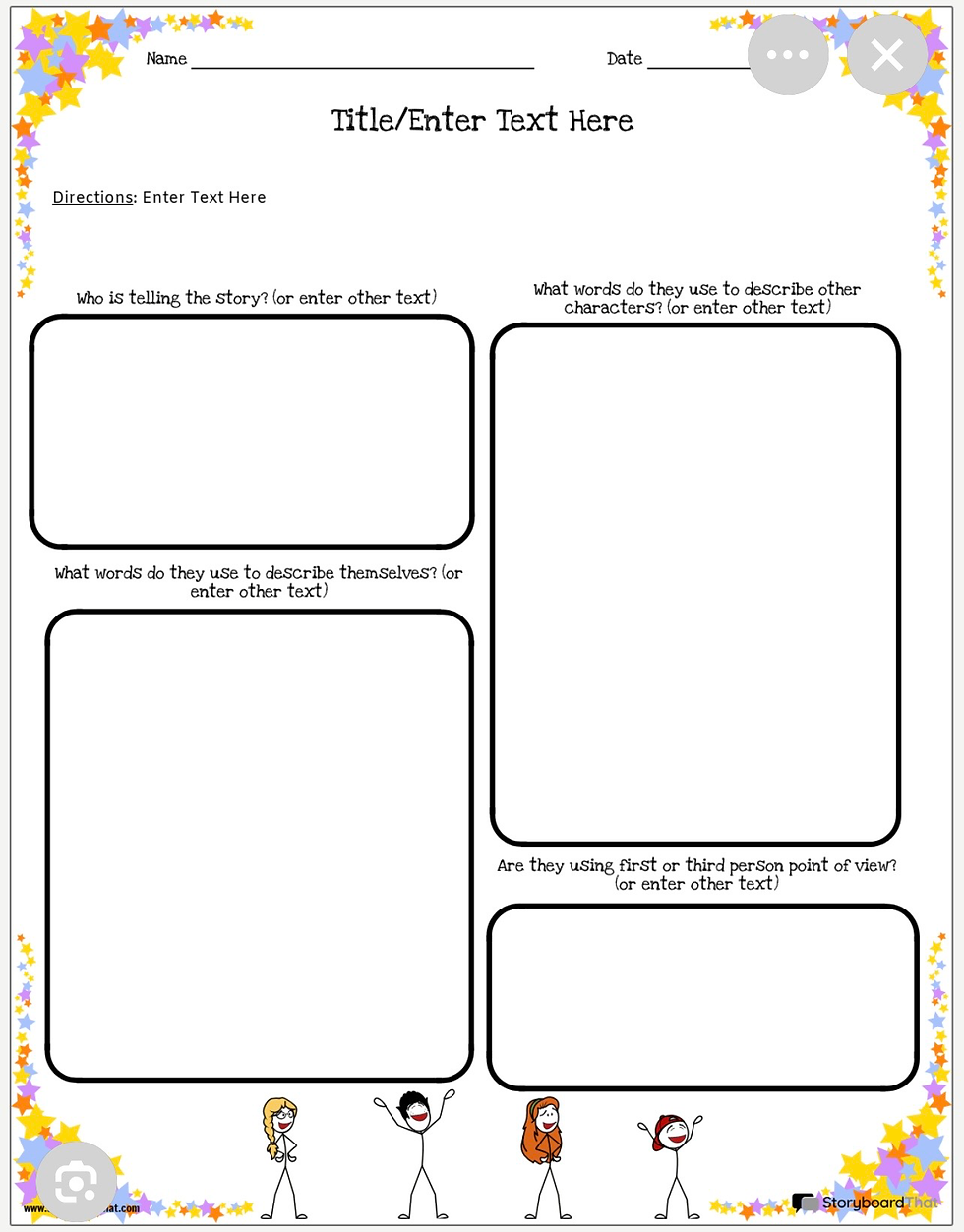
The image below is a printable worksheet which you can print and use to start your storytelling journey.
2) In this month's education section, I will focus on "why self-expression matters in early learning" and how expression supports literacy, confidence and classroom participation.
For every parent or teacher, care giver, etc who eagerly awaited for a child to begin babbling, chatting and made up their own stories, a smile or giggle was most likely ready to take place every time they opened their mouths. When children begin to express their feelings, words, sounds, it is a wonderful step to independence for communication. Repeating sounds and actions are expressions of self interpretation and an important part of a child engaged in some form of communication.
Young ones who do not yet string words together to form simple sentences but who say one word responses or use body language to indicate an understanding of a question, are beginning to put together the necessary tools for reading and are developing the confidence required for learning. A wordless book filled with illlustrations gives a child the opportunity to participate in making a story based on seeing pictures they are familiar with. A simple book about farm animals and where they spend their time on a farm, or a parent walking in a park with a child visiting a duck pond, can provide a child with an imagaination needed to express their ideas on a story just from looking at pictures. Providing opportunities like these will give children confidence to go further and develop literacy skills that encourage class participation as they grow.
Teaching children to use their imagination and make stories up through common experiences is also a tool that enhances participation. A story about a time they saw something unusual, went to a party but it was the wrong day, or a family event helps children learn opinions, viewpoint and that not everyone has the same experiences.
Once children have a comfortable vocabulary, they often enjoy looking at books or make up stories to repeat over again. Using pictures from magazines or newspapers to encourage a community of learnin through storytelling at home brings a sense of confidence in the classroom. Show and tell events also give children a BIG opportunity to speak in front of their peers and describe clues to the mystery item they want to share that is hidden in a paper bag.
When I taught preschool, show and tell was a huge part of our morning meeting. Kids love to talk about their special item. In the beginning, they brought anything they wanted to share, but after they got familiar with the process, we used themes to narrow down their ability to step "outside the box" and find

words to describe items that may not be so familiar to children on a day by day basis. Questions after the clues given increased their knowledge of how to respond. The staff always enjoyed hearing the kids give the clues and the comments were always a big laugh! Encouraging children to do a Show and Tell at home before dinner could create a fun family routine that everyone can participate in. All of these types of self-expressive moments increases verbal and cognitive skills that create a love for reading, writing and communication in class and at home.
3) For this month's parenting read, we will discuss supporting "Quiet Confidence" in children and the practical ways to give them support when they express themselves in a quiet manner.
So often among parents with quiet or introverted children, the objective, at times, is to bring out their confidence by trying to boost them in a loud or overpowering way in the hopes that they will "pick up" the habit of confidence and follow others who don't hold back.
For myself, having three children with three totally different personalities and temperaments, I can say that I had to handle this issue differently with all three. Some children have just the right amount of confidence to speak their mind in a polite and mature way and others may come across as shy or "uncaring" because they may lack the "BIG VOICE" that is needed to carry them through conversations, lessons or being able to give their opinion with a secure result.
Firstly, remember that some children are deep thinkers and like to take their time in speaking up or speaking out. They may be highly sensitive as well and can feel overwhelmed so they remain quiet so as to not be difficult. For other children, being socially anxious can affect their performance and worry they are being made fun of or stared at, which produces more emotional insecurity.
Some ideas that help to bring out the "voice" in a quiet child and assist them to develop secure and confident interactions are to build their decision making by helping them avoid open ended questions, which can pressure them further. Ask questions that require then to make a choice and participate, such as, "do you want cereal or pancakes for breakfast?" instead of asking, "what would you like to eat?" The former makes a child choose between two options so they don't have to spend time finding ways to express their wants and get frustrated when they can't make a decision.
Given children acknowledgment when they attempt something new so they are aware of their ability to try, even if it is not completed. The best ways to let children learn it by modeling self-expression and share your feelings, thoughts and ideas with them. The more they hear a parent share what they feel or do, the more normal it becomes for a child to follow.
Be consistent and continue to praise them even on days when they are less extroverted. The confidence will build slowly but steadily. A family activity that encourages this is to create a family story told from different viewpoints. It could be done like a board game using made up cards from index card stock and dice or a spinner to play and each family member takes a turn by adding their own viewpoint to a story.
To make it extra fun, try using a tape recorder to play back so everyone hears their own voice and can make comments on how
they sound, what description they used, etc. You can even try listening to a podcast as a family and hear how the host and guests respond.
Using all the tools available can make a big difference and the results will be BIG VOICES coming through!

Have a great month and see you back in February to discuss Empathy and Understanding.


Comments